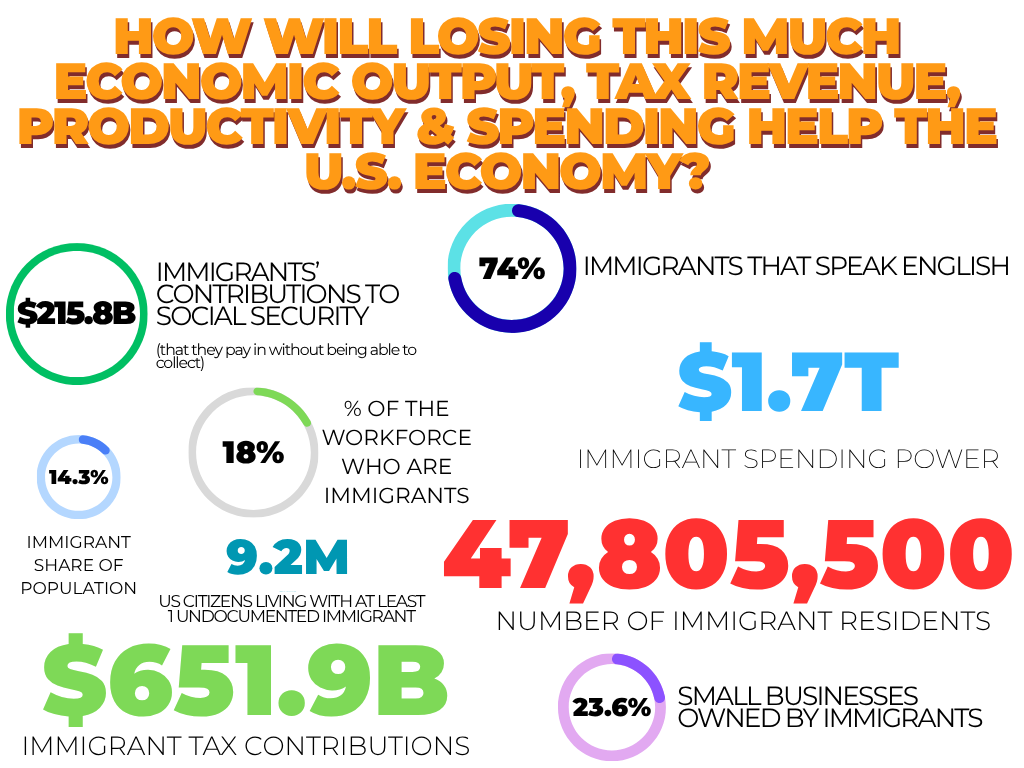
In 2022 undocumented immigrants paid a total of $92 BILLION on their federal income taxes according to the Institute on Taxation and Economic Policy. That is close to the amount of money the people of the US paid in tariffs during 2025’s experiment with acting like bumbling buffoons. Since undocumented immigrants usually do not qualify for benefits or deductions, leading them to pay a larger share of their income than many American citizens, they represent a massive source of revenue for the government and there does not appear to be any plan for what the US is going to do about the massive amount of tax revenue the US will be permanently losing as a result of Trump’s immigration policies.
In New York there are an estimated 4,810,000 immigrants who make up 25% of the population of the state according to forward. Ten percent of New Yorkers are undocumented or live with an undocumented immigrant, which is almost two million people. There are also hundreds of thousands of immigrants in New York with DACA or TPS as well who contribute about $4.5 billion annually to the economy of the state. Immigrants live in 32% of households in New York and make up 29% of New York’s labor force (38% of the construction industry and 31% of hospitality). In New York City immigrants make up 32% of the population and immigrants live in 42% of households. 90% of the immigrants in NYC speak English and over a half a million of them are self-employed paying $108 billion in annual combined taxes. Learn more about the immigrant population of New York City.
The immigrants in New York have a combined annual spending power of $184 billion and pay about $80 billion in taxes every year. Immigrants are contributing much more in taxes than they are receiving in any sort of benefits. Claims that immigrants come to New York and live large in five star hotels for free milking the taxpayers are simply not true. They are lies.
Under Trump’s immigration policies, New York’s economy could lose up to $18.8 billion annually, in addition to an estimated $3.3 billion in foregone state and local taxes contributed by these workers each year. Nationwide, American families are expected to see a $2,150 annual increase to the combined everyday goods and services they purchase under new immigration policies expected from the Trump administration.
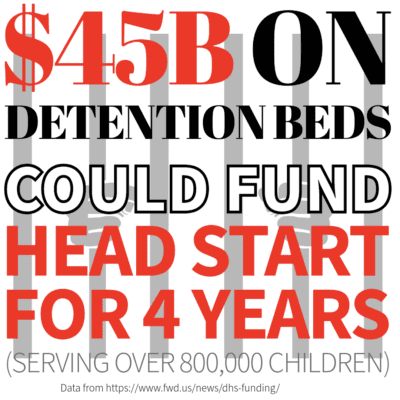
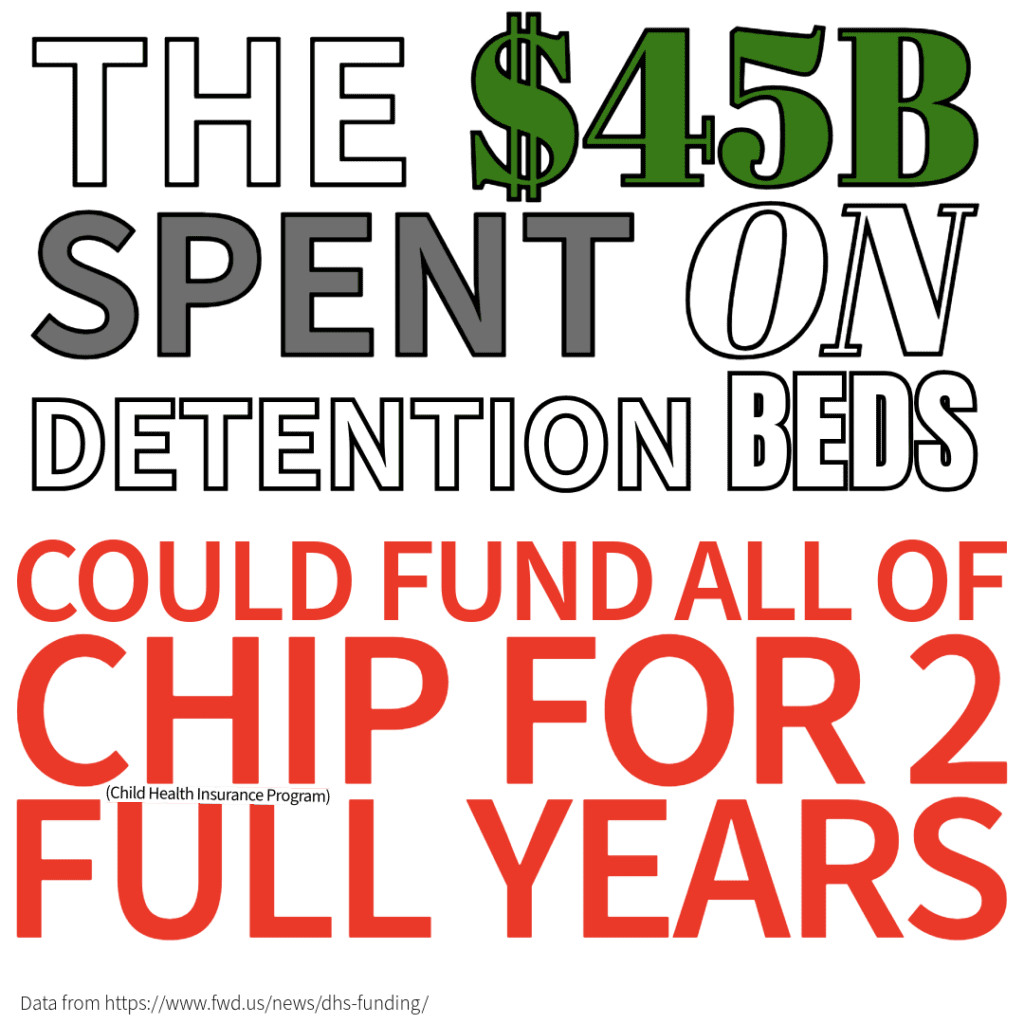
Government spending has increased substantially. The United States Treasury is paying $3 BILLION a day in interest payments alone. According to the Congressional Budget Office, the U.S. Treasury has paid $628 billion in net interest this year to service its borrowing–That is more than the cost of Medicare and Medicaid. Then we have all the increased spending on Trump’s (Stephen Miller’s) immigration policy. The 2025 reconciliation bill that has become known as the Big Beautiful Bill, for some reason, allocated an unprecedented $191 billion to DHS for the remainder of the Trump presidency. $74.85B has been spent on ICE jails.
Undocumented immigrants pay about $66 BILLION each year in payroll and federal income taxes.
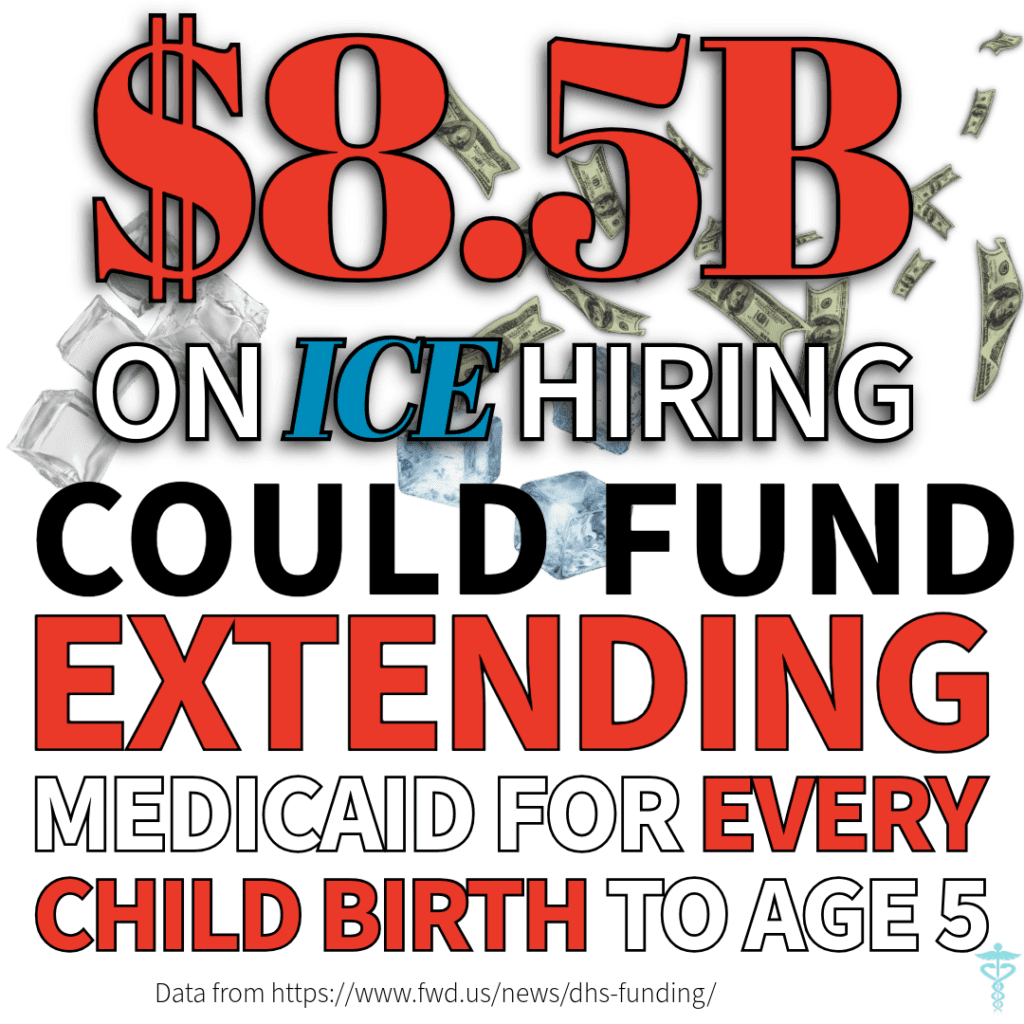
$2.1B has been spent on ICE hiring/retention bonuses alone. Giving $50,000 to every unemployed man under 45 with a GED and a desire to stop “the browning of America.” $137,000,000 has been given to local police department for them to play pretend as immigration enforcement and they are projected to send $2,000,000,000 to local police in 2026. ICE has deputized 13,800–15,800 local law enforcement officials.
To put this in context, the budget for ICE in 2024 was $9B. Trump has 10x’d the ICE budget that was in place when he took office. The ICE budget is now double that of the US Marines.
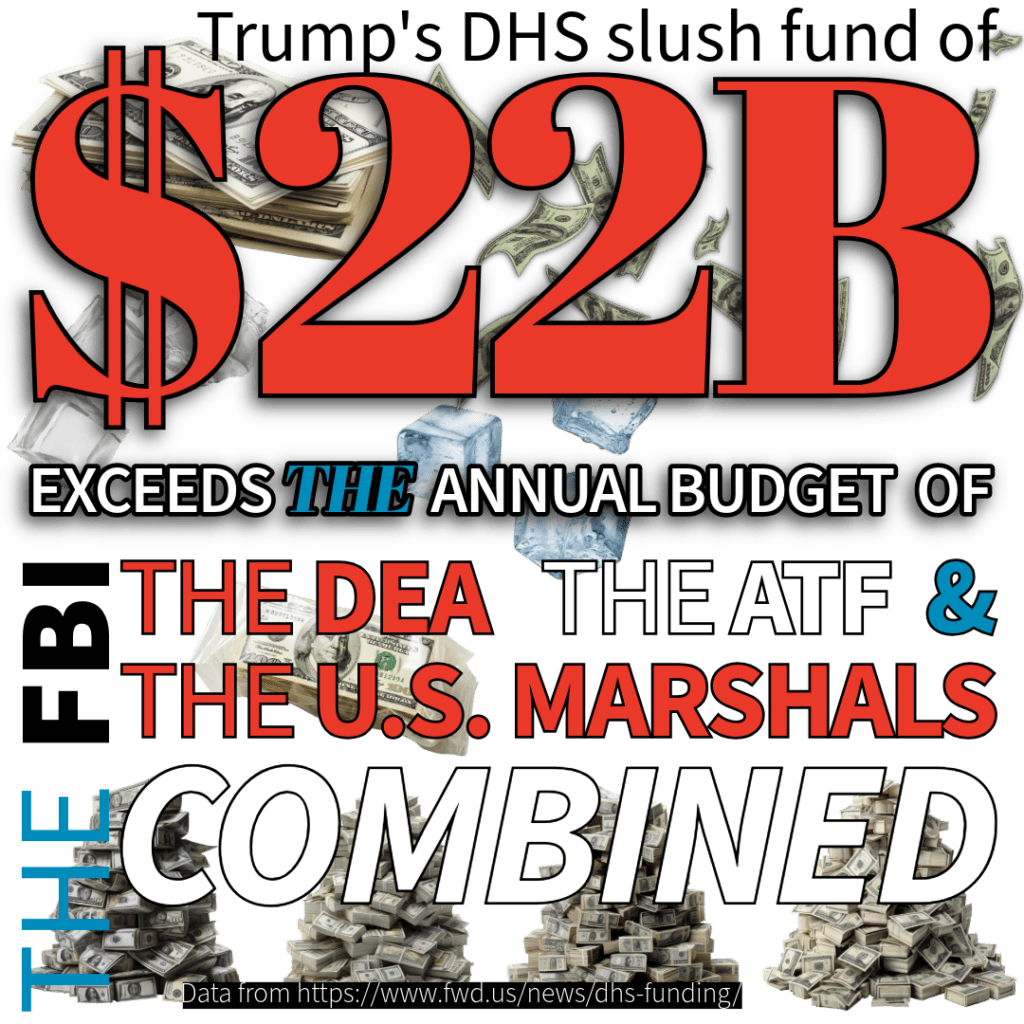
There is also the matter of the $22B slush fund that has no accounting. There was $22 billion dollars given to DHS with no explanation of what it is to be used for and no oversight for how it will be used. No reporting requirements, no spending benchmarks, no performance metrics. Congress gave DHS a blank check.
$22 billion exceeds the annual budgets of the FBI ($11.4B), DEA ($3.2B), ATF ($1.7B), and U.S. Marshals ($4.1B) combined.
See the numbers here.
For context: DHS’s $22 billion slush fund alone exceeds the annual budgets of the FBI ($11.4B), DEA ($3.2B), ATF ($1.7B), and U.S. Marshals ($4.1B) combined.
At a Congressional hearing, Federal Reserve Board Chair Jerome Powell said the Trump administration’s deportation policies are one of the reasons U.S. economic growth has slowed. Noting that the mass-deportations will significantly impact the economy affecting 5% of the economy—construction, hospitality and agriculture. Fed Chair Powell said, “There are two things that affect growth. One is growth in the labor force, more people working, and the other thing is productivity, how much do they produce per hour of work. And when you significantly slow the growth of the labor force, you will slow the growth of the economy.” This is according to reporting by Forbes.
A report titled, Immigration and the macroeconomy in the second Trump administration, by the Brookings Institute concluded, “we project that immigration policy under the new Trump administration will reduce 2025 GDP growth by between 0.1 (“high” scenario) and 0.4 percentage points (“low” scenario), or by $30 to $110 billion.”
Key financial and economic impacts include:
- Up to a 75% drop in tax filings among undocumented households in some communities, driven by fear of deportation.
- Loss of $96.7 billion in tax payments made annually by undocumented immigrants, who often pay a higher effective tax rate than citizens due to ineligibility for deductions.
- A broader economic risk: negative net migration since 2025 could reduce U.S. GDP growth by 0.3% to 0.4% annually, amounting to $70.5–94 billion in lost output per year.
- $170 billion allocated to enforcement through 2029, including funding for ICE, detention centers, and border barriers under the “One Big Beautiful Bill.”
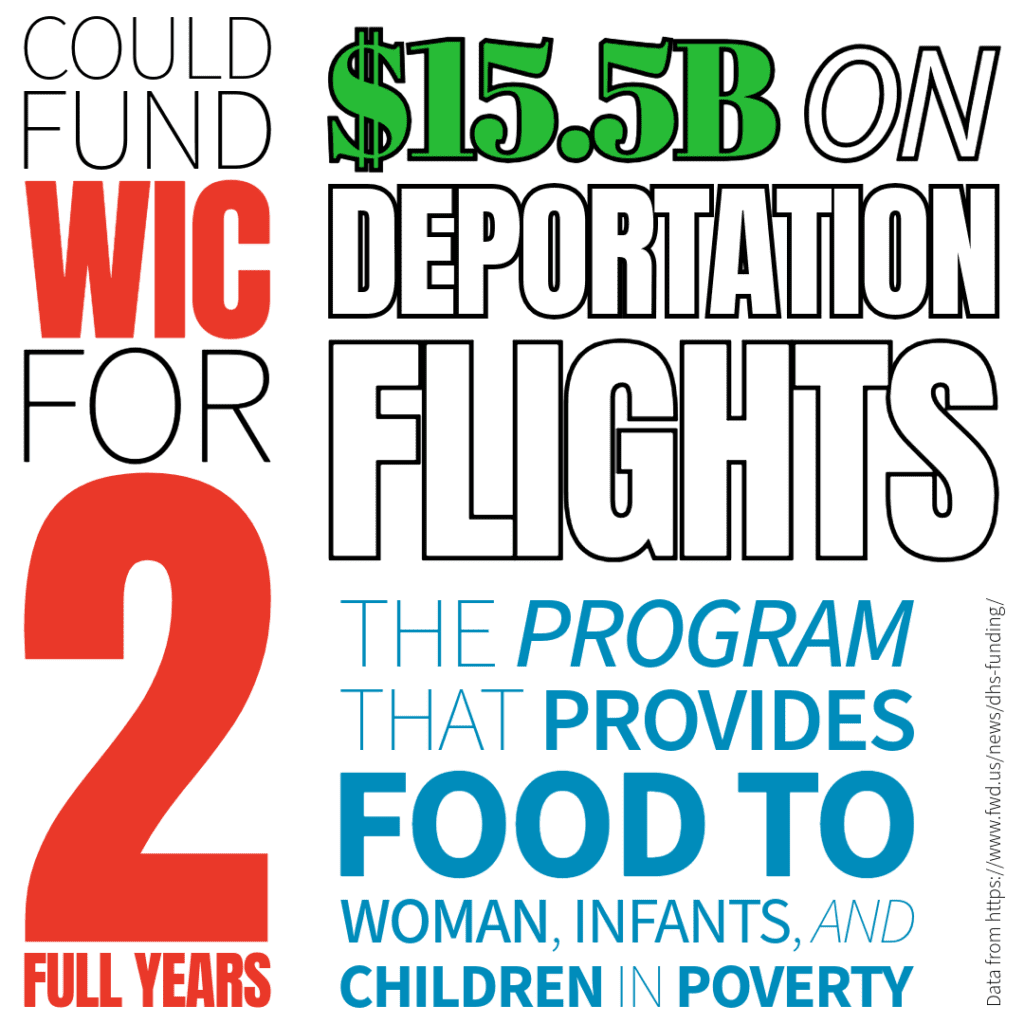
This data is from the forward website, which has some amazing information including an entire page dedicated to DHS funding and spending (https://www.fwd.us/news/dhs-funding).